All posts by Andrew

Visit to FTW, Vienna

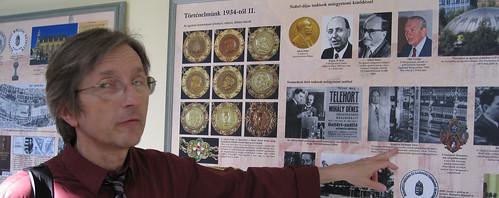
On June 4, 2010 I visited the Telecommunications Research Center Vienna (FTW). My host was Peter Froehlich, Senior Researcher in FTW’s User-Centered Interaction area of activity. Peter and I met at the CHI SIG meeting on automotive user interfaces [1] that I helped organize.

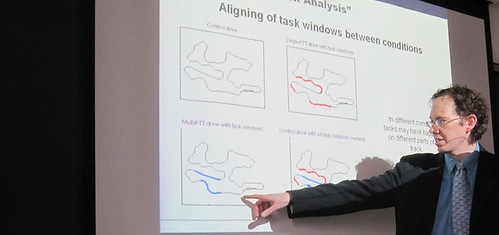
Peter and his colleagues are investigating automotive navigation aids and are currently preparing for an on-road study. I’m happy to report that this study will utilize one of our eye trackers. My visit provided an opportunity for us to discuss this upcoming study and how the eye tracker may be useful in evaluating the research hypotheses. Part of this discussion was a Telecommunications Forum talk I gave – see the slides below:

I want to thank Peter and his colleagues at FTW for hosting me and I’m looking forward to our upcoming collaboration. I also want to thank FTW for providing funding for my visit.

References

[1] Albrecht Schmidt, Anind L. Dey, Andrew L. Kun, Wolfgang Spiessl, “Automotive User Interfaces: Human Computer Interaction in the Car,” CHI 2010 Extended Abstracts

Albrecht Schmidt visit to UNH

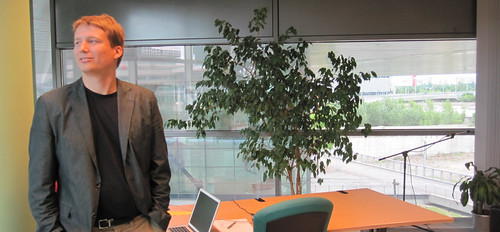
Last month (April 16) Albrecht Schmidt visited UNH and the Project54 lab. Albrecht gave an excellent talk introducing some of the research problems in pervasive computing and specifically touching on the latest results from his lab, which were just published at CHI 2010 [1, 2]. I was especially interested in the work on helping users find the last place of interest on a map quickly. Albrecht and colleagues track the user’s gaze and when the user looks away, they place a marker (or gazemark) on the map. When the user looks back at the map she can start where she left off: at the place of the marker. Clearly this could be very useful when looking at GPS maps in a car. In such a situation the driver has to keep going back and forth between the map and the road and you want to minimize the time spent looking at the map (the road being the more important thing to look at!). The gazemarks introduced by Albrecht’s group may help. It would be interesting to conduct a driving simulator study with gazemarks.

After the talk Albrecht spent about an hour with students from the Project54 lab and those in my Ubicomp Fundamentals course. This was a more intimate setting for conversations about Albrecht’s research. Finally, Project54 staff and students spent a couple of hours discussing Project54 research with Albrecht – our work on handheld computers, on driving simulator-based investigations of in-car user interfaces and our budding efforts in multi-touch table interaction.

I am grateful to the UNH Provost’s Office for helping to fund Albrecht’s visit through a grant from the Class of 1954 Academic Enrichment Fund.

References

[1] Dagmar Kern, P. Marshall and Albrecht Schmidt, ” Gazemarks: gaze-based visual placeholders to ease attention switching,” CHI 2010

[2] Alireza Sahami Shirazi, Ari-Heikki Sarjanoja, Florian Alt, Albrecht Schmidt, and Jonna Häkkilä, J. “Understanding the impact of abstracted audio preview of SMS,” CHI 2010

MERL gift

I’m happy to report that I received a gift grant in the amount of $5,000 from Mitsubishi Electric Research Laboratories (MERL). The gift is intended to support my work on speech user interfaces and it was awarded by Dr. Kent Wittenburg, Vice President & Director of MERL.

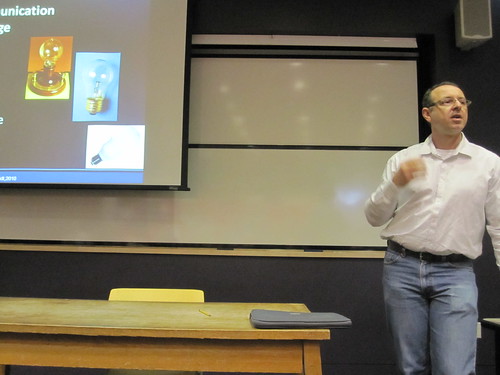
This gift comes in the context of ongoing interactions between researchers at MERL and my group at UNH. Kent and Bent Schmidt-Nielsen hosted me several years ago for a demonstration of the Project54 system (I drove to Boston in a police SUV, which was fun), and I also gave a talk at MERL last fall.  In 2009 my PhD student Zeljko Medenica worked as a summer intern at MERL under the direction of Bret Harsham (Bret recently gave a talk at UNHon some of this work – see picture below). Zeljko is headed back to MERL this summer and he will work under the direction of Garrett Weinberg.

I greatly appreciate MERL’s generous gift and I plan to use it to help fund a graduate student working on speech user interfaces. I hope to report back to Kent, Bent, Bret and Garrett on the student’s progress by the end of this summer.

Project54 on front page of New York Times

In a front page article of the March 11, 2010 edition of the New York Times Matt Richtel discusses in-vehicle electronic devices used by first responders. Based on a number of interviews, including one with me, Matt gets the point across that interactions with in-vehicle devices can distract first responders from the primary task for any driver: driving. The personal accounts from first responders are certainly gripping. Thanks Matt for bringing this issue to the public.

Enter Project54. According to Matt “[r]esearchers are working to reduce the risk.” He goes on to describe UNH’s Project54 system which allows officers to issue voice commands in order to interact with in-car electronic devices. This means officers can keep their eyes on the road and their hands on the wheel. The article includes praise for the Project54 system by Captain John G. LeLacheur of the New Hampshire State Police. The Project54 system was developed in partnership with the NHSP and almost every NHSP cruiser has the Project54 system installed.

Both the print and the online versions of the article begin with a picture of the Project54 in-car system. This great picture was taken by Sheryl Senter and it shows Sergeant Tom Dronsfield of the Lee, NH Police Department in action.

Alex Shyrokov defends PhD

Two weeks ago my student Alex Shyrokov defended his PhD dissertation. Alex was interested in human-computer interaction for cases when the human is engaged in a manual-visual task. In such situations a speech interface appears to be a natural way to communicate with a computer. Alex was especially interested in multi-threaded spoken HCI. In multi-threaded dialogues the conversants switch back and forth between multiple topics.

How should we design a speech interface that will support multi-threaded human-computer dialogues when the human is engaged in a manual-visual task? In order to begin answering this question Alex explored spoken dialogues between two human conversants. The hypothesis is that a successful HCI design can mimic some aspects of human-human interaction.

In Alex’s experiments one of the conversants (the driver) operated a simulated vehicle while the other (an assistant) was only engaged in the spoken dialogue. The conversants were engaged in an ongoing and in an interrupting spoken task. Alex’s dissertation discusses several interesting findings, one of which is that driving performance is worse during and after the interrupting task. Alex proposes that this is due to a shift in the driver’s attention away from driving and to the spoken tasks. The shift in turn is due to the perceived urgency of the spoken tasks – as the perceived urgency increases the driver is more likely to shift her attention away from driving. The lesson for HCI design is to be very careful in managing the driver’s perceived urgency when interacting with devices in the car.

Alex benefited tremendously from the help of my collaborator on this research Peter Heeman. Peter provided excellent guidance throughout Alex’s PhD studies for which I am grateful. Peter and I plan to continue working with Alex’s data. The data includes transcribed dialogues, videos, driving performance as well as eye tracker data. I am especially interested in using the eye tracker’s pupil diameter measurements to estimate cognitive load as we have done in work lead by Oskar Palinko [1].

References

[1] Oskar Palinko, Andrew L. Kun, Alexander Shyrokov, Peter Heeman, “Estimating Cognitive Load Using Remote Eye Tracking in a Driving Simulator,” ETRA 2010

Automotive user interfaces SIG meeting to be held at CHI 2010

There will be a special interest group (SIG) meeting on automotive user interfaces at CHI 2010. The lead author of the paper describing the aims of the SIG [1] is Albrecht Schmidt and the list of coauthors includes Anind Dey, Wolfgang Spiessl and me. CHI SIGs are 90 minute scheduled sessions during the conference. They are an opportunity for researchers with a common interest to meet face-to-face and engage in dialog.

Our SIG deals with human-computer interaction in the car. This is an exciting field of study that was the topic of a CHI 2008 SIG [2] as well as the AutomotiveUI 2009 conference [3], and the AutomotiveUI 2010 CFP will be posted very soon. In the last several years human-computer interaction in the car has increased for two main reasons. One, many cars now come equipped with myriad electronic devices such as displays indicating power usage and advanced driver assistance systems. Second, users (drivers and passengers) bring mobile devices to cars. The list of these brought-in mobile devices is long but personal navigation devices and mp3 players are probably the most common ones.

At the SIG we hope to discuss user interface issues that are the result of having all of these devices in cars. Some of the questions are:

  • How can we reduce (or eliminate) driver distraction caused by the in-car devices?
  • Can driver interactions with in-car devices actually improve driving performance?
  • Can users take advantage of novel technologies, such as streaming videos from other cars?
  • How do we build interfaces that users can trust and will thus actually use?
  • How can car manufacturers, OEMs, brought-in device manufacturers and academia collaborate in envisioning, creating and implementing automotive user interfaces?

The 2008 CHI SIG [2] attracted over 60 people and we’re hoping for similar (or better!) turnout.

References

[1] Albrecht Schmidt, Anind L. Dey, Andrew L. Kun, Wolfgang Spiessl, “Automotive User Interfaces: Human Computer Interaction in the Car,” CHI 2010 Extended Abstracts (to appear)

[2] D. M. Krum, J. Faenger, B. Lathrop, J. Sison, A. Lien, “All roads lead to CHI: interaction in the automobile,” CHI 2008 Extended Abstracts

[3] Albrecht Schmidt, Anind Dey, Thomas Seder, Oskar Juhlin, “Proceedings of the 1st International Conference on Automotive User Interfaces and Interactive Vehicular Applications, 2009”

Estimating cognitive load using pupillometry: paper accepted to ETRA 2010

Our short paper [1] on using changes in pupil size diameter to estimate cognitive load was accepted to the Eye Tracking Research and Applications 2010 (ETRA 2010) conference. The lead author is Oszkar Palinko and the co-authors are my PhD student Alex Shyrokov, my OHSU collaborator Peter Heeman and me.

In previous experiments in our lab we have concentrated on performance measures to evaluate the effects of secondary tasks on the driver. Secondary tasks are those performed in addition to driving, e.g. interacting with a personal navigation device. However, as Jackson Beatty has shown, when people’s cognitive load increases their pupils dilate  [2]. This fascinating phenomenon provides a physiological measure of cognitive load. Why is it important to have multiple measures of cognitive load? As Christopher Wickens points out [3] this allows us to avoid circular arguments such as “… saying that a task interferes more because of its higher resource demand, and its resource demand is inferred to be higher because of its greater interference.”

We found that in a driving simulator-based experiment that was conducted by Alex, performance-based and pupillometry-based (that is a physiological) cognitive load measures show high correspondence for tasks that lasted tens of seconds. In other words, both driving performance measures and pupil size changes appear to track cognitive load changes. In the experiment the driver is involved in two spoken tasks in addition to the manual-visual task of driving. We hypothesize that different parts of these two spoken tasks present different levels of cognitive load for the driver. Our measurements of driving performance and pupil diameter changes appear to confirm the hypothesis. Additionally, we introduced a new pupillometry-based cognitive load measure that shows promise for tracking changes in cognitive load on time scales of several seconds.

In Alex’s experiment one of the spoken tasks required participants to ask and answer yes/no questions. We hypothesize that different phases of this task also present different levels of cognitive load to the driver. Will this be evident in driving performance and pupillometric data? We hope to find out soon!

References

[1] Oskar Palinko, Andrew L. Kun, Alexander Shyrokov, Peter Heeman, “Estimating Cognitive Load Using Remote Eye Tracking in a Driving Simulator,” ETRA 2010

[2] Jackson Beatty, “Task-evoked pupillary responses, processing load, and the structure of processing resources,” Psychological Bulletin. Vol. 91(2), Mar 1982, 276-292

[3] Christopher D. Wickens, “Multiple resources and performance prediction,” Theoretical Issues in Ergonomic Science, 2002, Vol. 3, No. 2, 159-177

Promoting the CEPS-BUTE Exchange Program

In an effort to promote the CEPSBUTE exchange program I gave the following presentation to two similar audiences here at UNH. Last Monday Kent Chamberlin hosted me in his ECE 401 class (the introductory ECE course) and I had a chance to talk to about 75 ECE freshmen. Today I gave the presentation to Bob Henry’s TECH 400 students (TECH 400 introduces the CEPS majors to CEPS undeclared students).

View more presentations from Andrew Kun.

My main point was this: spending a semester abroad gives students a competitive advantage because it proves that they can adapt to change. Of course spending a semester in Europe allows students to travel and I spent some time promoting my favorite travel guide author, Rick Steves 🙂

NSF SBIR review panel

On Thursday I participated in a Phase II National Science Foundation Small Business Innovation Research (NSF SBIR) panel. While I’ve been to Phase I panels before, this was my first Phase II panel. In Phase I companies can request up to $150,000 for 6 months to a year. A company that receives a Phase I award, and successfully delivers on its grant, is eligible to compete in Phase II with a proposal for up to $500,000 for two years. 

The one thing that always strikes me at the SBIR panels is that proposals have to make a good business case. Panels include both technical experts and business experts and a proposal has to clear the bar with both sets in order to be recommended for funding. I’ve always taken it for granted that an NSF proposal (SBIR or scientific) should make a good argument for why the technology or scientific innovation is worth funding. However, before my involvement in the SBIR review process, I didn’t really think much about the business case to be made when requesting funding for a business venture. In this respect I’m hardly alone: engineers usually don’t spend much time exploring the business side of running a business. At the UNH ECE department we’re looking into alleviating this problem through the involvement of Brad Gillespie in our senior project courses. Brad is a UNH ECE alumnus, Microsoft veteran and business strategy consultant. Read about Brad’s last visit to UNH ECE and check back for more on this in a future post.

So, if you’re a technical person planning to submit an SBIR proposal (note that many federal agencies run SBIR programs, not just the NSF), my advice is this: bring in people who can help you think through (and coherently present in the proposal) a business plan for your venture. Without a compelling business plan your proposal will not be funded.

At the 2009 fall NIJ CommTech TWG meeting

On Wednesday and Thursday, Oskar Palinko, Mark Taipan and I participated in the NIJ CommTech Technical Working Group meeting. On Wednesday I gave the presentation below reporting on our lab’s progress.

View more presentations from Andrew Kun.

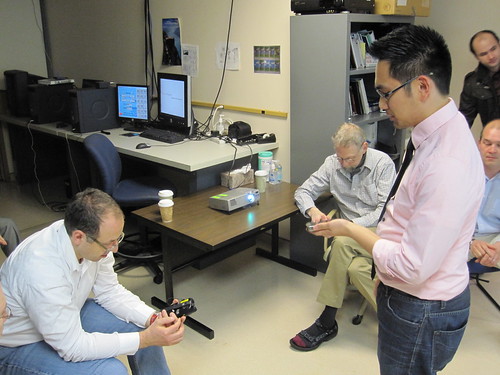
On Thursday we participated in the meeting’s demo session. We demonstrated the advantage of using voice commands to control a police radio over using the radio’s buttons. We used a single-computer driving simulator and a radio setup. Of course the first driving simulator experiment we published investigated this effect [1]. We also demonstrated accessing a remote database using the Project54 system running on a Symbol handheld computer. We expect that, once we get approval from the NH State Police to deploy such devices (NHSP is responsible for data access for all officers in the state), they will be a big hit with local departments.

One of the many people we had a chance to talk to at the TWG meeting is Gil Emery, Communications Manager at the Portsmouth, NH PD. Gil was interested in the handhelds and we may be able to work with him on using these handhelds as cameras that allow tagging pictures on the spot and then using a cellular network to transmit them to headquarters. This work would build on Michael Farrar’s MS thesis research.

You can see pictures from this event of Flickr.

References

[1] Zeljko Medenica, Andrew L. Kun, “Comparing the Influence of Two User Interfaces for Mobile Radios on Driving Performance,” Driving Assessment 2007